Blog

How Body Cameras Improve Public Safety

Looking Through a Different Lens: Body Cameras Improve Public Safety by Capturing and Deterring
-
Wednesday July 29, 2026  |  5 min read

Block by Block began testing body cameras about a year ago, bringing an added dimension of security and trust for both the Ambassadors who wear them and the communities they serve.

Based on the success and lessons learned from pilot deployments, body-worn cameras are now standard issue for Community Response Officers (CROs) with Block by Block’s affiliate company, Civicity.

Civicity is a human-centered public safety model developed by Block by Block for modern public spaces, including downtowns, entertainment districts, campuses and transit environments.

“Part of using body cams is to raise the bar as far as the professionalism of a security role or a safety role out in the public spaces,” said Steve Saunders, Civicity’s Vice President of Security Strategy. “It really promotes transparency, professionalism and builds public trust. And those are key elements in why you would have body cams on your uniform as you’re out in the public spaces.”

Body cameras support efforts from de-escalating situations to assisting police with investigations, serving as a reliable source of factual information when needed.

“In my experience, body cams do a great job of providing factual information,” Saunders said. “Sometimes when emotions get elevated, interactions can be misinterpreted, but the body camera captures the video and audio exactly as it happened. It’s very unbiased, so it’s a very good tool for that purpose.”
How do Civicity officers wear body cameras?

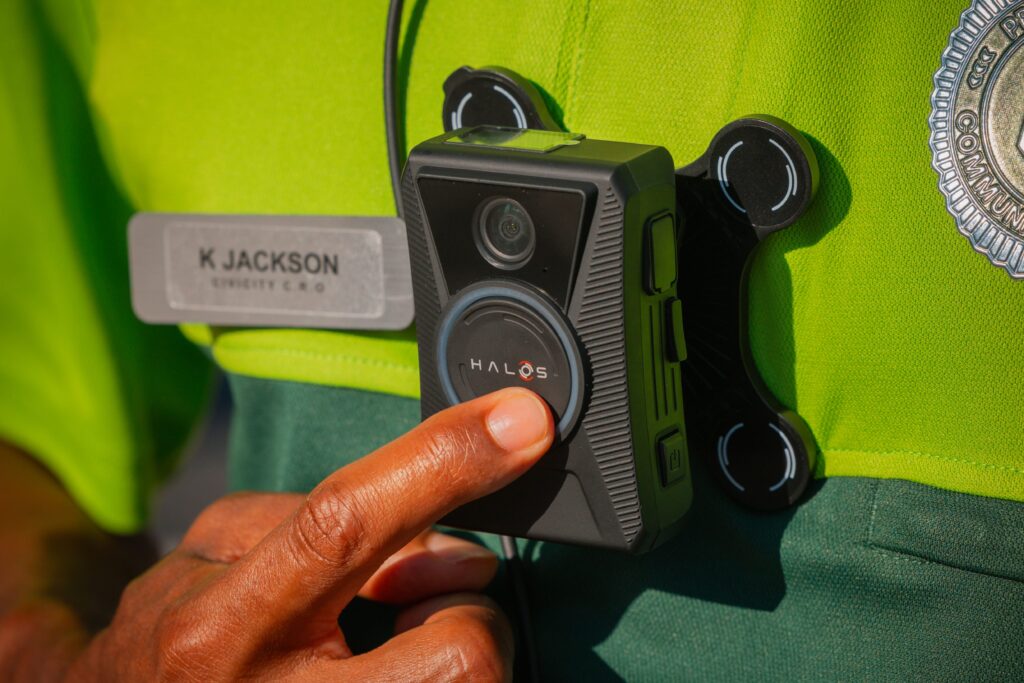
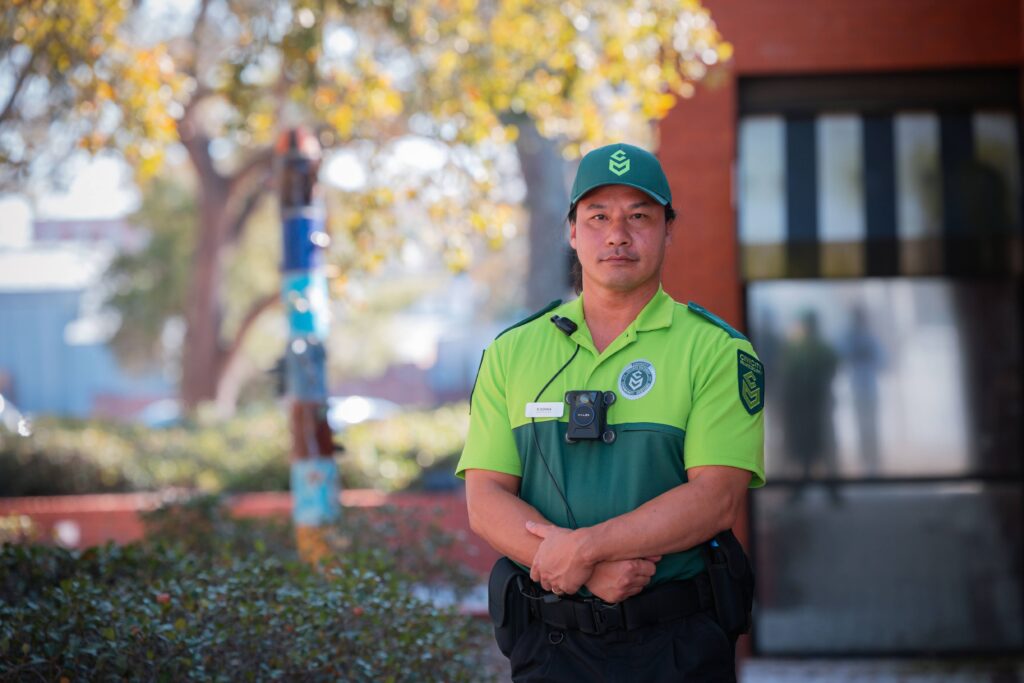
CROs and Ambassadors wear body cameras on a harness in the center of their chest, so anyone they encounter can see they are recording — an important step in building public trust and creating calm.

Destiny Mosley, Operations Manager for Block by Block’s Ambassador Program with Louisville Downtown Partnership, has seen firsthand how body cameras have helped.

“It really makes the team feel more confident in the work that they’re doing,” Mosley said. “They can focus on their work without questioning their actions because if something happens, it’s all on camera. There’s no question about it. I think it also builds trust within the community because they know we are taking our job seriously.”

Mosley also says body cameras are a valuable training tool for Ambassadors because supervisors can review footage of responses and openly discuss how to better prepare and improve.

The de-escalation benefits of body cams shouldn’t be overlooked, Saunders added. As CROs and Safety Ambassadors with body cameras arrive during a disruptive or unruly gathering, noise and activity tends to calm down.

“People pay attention and are on their best behavior when they see the cameras,” Saunders said. “Then, our team can talk calmly and use their de-escalation skills to address any problems and get help, if needed.”
What kind of cameras do Block by Block and Civicity use?

While Ambassadors use various versions of body cameras, Civicity CROs are equipped with HALOS units as part of their standard uniform equipment.

The high-quality cameras sync with the company’s SMART system and upload video in real time. The SMART System is Block by Block’s proprietary data collection and accountability platform. Footage stored in SMART can be shared with company leaders, partners or authorities.

With real-time access, Operations Managers are able to better support Ambassadors and CROs remotely, even while a response is underway.

“If something is happening in the field, even if it’s not an emergency, we can pull up live footage and guide them through the situation, “Mosely said.

Body cameras have also helped Block by Block and Civicity better tell the story of the work being done in the communities they serve.

“It’s an advantage for our customers, too. They see us out working, and we can show them the evidence of what we do,” Saunders said “Sometimes that work is challenging — interacting with individuals facing mental health or substance abuse issues, or those in need of serious intervention. We can share that confidentially with our customers to validate both the importance and impact of our work.”

As body camera technology continues to evolve, it’s clear these devices are not only a tool for safety but also a critical part of building trust, improving performance and strengthening the connection between Block by Block, Civicity and the communities we serve.

Civicity Launches Public-Space Safety Program in Columbus’ Short North Arts District 

-
Wednesday July 1, 2026  |  5 min read

Safety Response Team complements existing Ambassador Programming

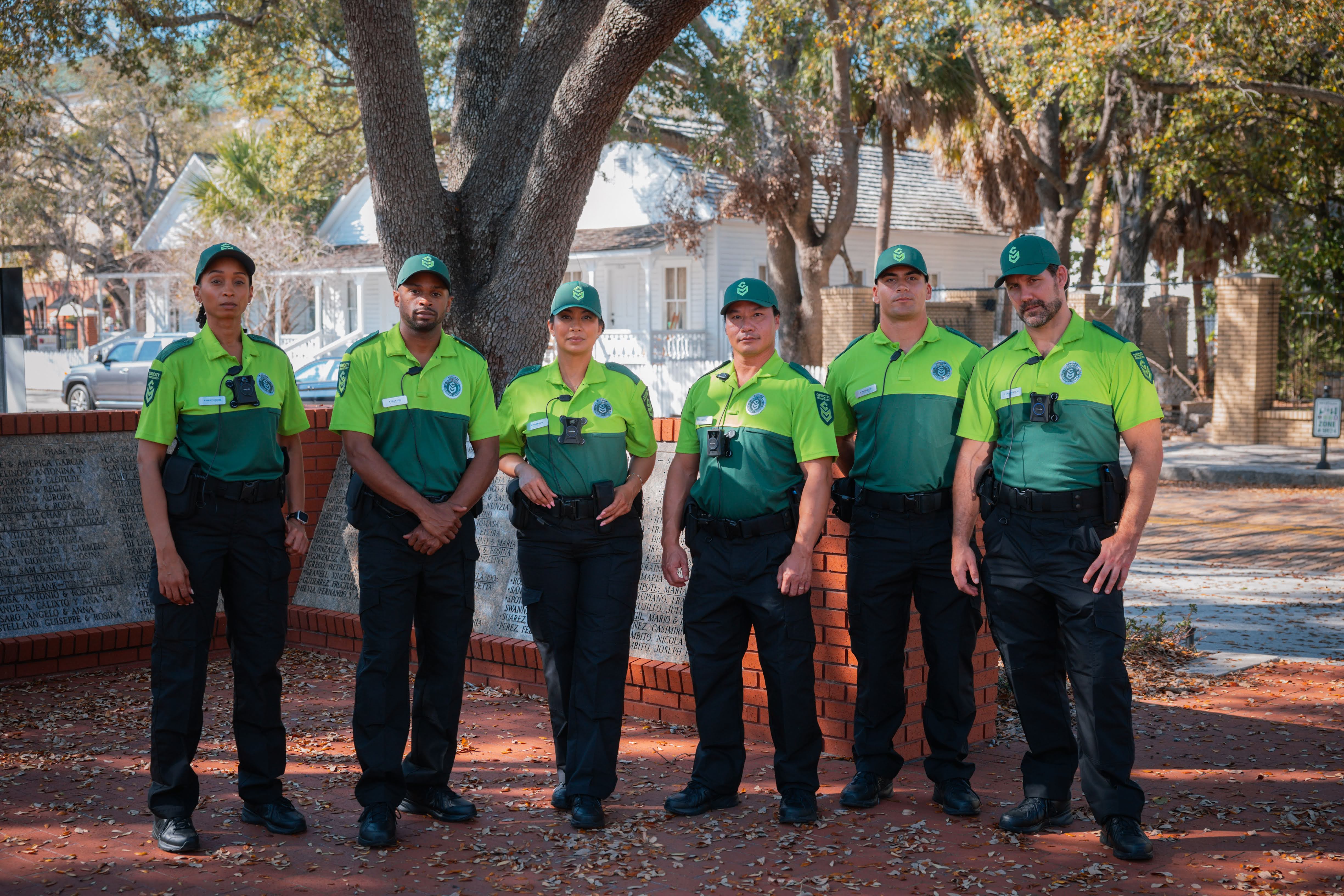
Building on a Community Ambassador Program that has supported Short North Arts District for nearly five years, the Short North Alliance has engaged Civicity to add a Safety Response Team of Security Ambassadors to further support safety, visibility and confidence in one of Columbus’ most vibrant neighborhoods. 

Work with Civicity, a new security division of Block by Block, marks an evolution of the company’s work in the Short North Arts District, complementing safety and hospitality programs provided by Block by Block while adding a specialized focus on public‑space safety during key periods. 

“Communities like the Short North succeed when people feel comfortable being present, whether they operate businesses, work here or are visiting,” Steve Saunders, Vice President of Security Strategy for Block by Block, said. “Civicity builds on years of experience in this district by reinforcing visibility, early engagement and consistent response to the kinds of situations that shape how safe a place feels.” 

Civicity’s team of six, full-time Security Ambassadors began working with Short North May 1 deployed during four, 10‑hour shifts. The team operates Thursday through Sunday from 4:30 p.m. to 3 a.m., focusing on visibility, engagement and coordinated response during peak activity hours. 

Photo Credit: Katie Geniusz/WOSU

“The Short North has long taken a proactive, people-first approach to keeping the district welcoming, vibrant and well-supported,” Betsy A. Pandora, President and CEO of the Short North Alliance, said. “Our Short North Security Ambassadors, operated by Civicity, bring a visible, service-oriented model that complements the work already happening across the district and supports our focus on having the right resources in the right place at the right time. As we head into one of our busiest seasons, this partnership adds another layer of support for residents, businesses, workers and visitors.” 

Block by Block, a national leader managing safety, hospitality and outreach programs throughout the country, launched Civicity earlier this year to address growing needs for public-space safety options downtowns, entertainment and improvement districts, commercial and retail environments, college and off-campus areas and transit systems.  

Civicity employs teams of highly visible, uniformed professionals trained extensively in deescalation, trauma-informed engagement, situational awareness and customer service. They are supported by tools and reporting systems designed to strengthen visibility, accountability and coordinated response. 

Civicity is designed to help address non-emergency public-space needs through visible presence, de-escalation, outreach and coordinated support before issues escalate.  

“As public spaces continue to evolve, so must the approaches that support them,” Saunders said. “Offering Security Ambassadors through Civicity in the Short North reflects both the strength of this partnership and a shared commitment to creating environments where people want to be.” 

About the Short North Alliance 

The Short North Arts District is always creating what’s next. Explore the creative backbone of central Ohio — where the city comes to shop, taste and discover. Encounter vibrant happenings along High Street, where historic and modern buildings are home to 300+ independent shops, local restaurants and artful experiences. The Short North Alliance (SNA) is a 501(c)3 non-profit organization serving both the property and business owners of the Short North Arts District. For more information, visit www.shortnorth.org. 

About Civicity 

Civicity is a human-centered public safety model developed by Block by Block for modern public spaces, including downtowns, entertainment districts, campuses and transit environments. Through highly-trained teams supported by advanced technology and data driven reporting, Civicity helps public spaces feel safer, more welcoming and better prepared to support community life. For more information about Civicity, visit www.civicity.com. 

About Block by Block 

Block by Block has a robust history working in downtowns since their first program launched in Louisville, Ky., in 1995. More than strictly a clean and safe service provider, Block by Block has developed an optimized operating model built on best practices, research, development and modern technology that has attracted partners in more than 200 locations nationwide, including improvement districts, parks, college campuses, transit systems and other public spaces. 

Community Response Officers vs. Traditional Security 

-
Friday June 5, 2026  |  5 min read

Civicity’s CRO model emphasizes community, problem-solving solutions built for public spaces

If you ask Steve Saunders what separates Civicity’s Community Response Officers (CROs) from traditional security, he points to a single word: community. 

“The key to Civicity is community response,” he said. 

Civicity, the newly launched public security company from Block by Block, builds on the organization’s mission of improving public spaces—this time with a focused approach to safety and security. Saunders, a retired Cincinnati Police Department captain with 33 years of service, now serves as Vice President of Security Strategy overseeing the effort. 

“Unlike traditional security, which often protects property within a defined space, Civicity’s Community Response Officers are embedded in the districts they serve safeguarding the experience of being in a public space. 

“Traditional security is the eyes and ears on the inside of a space,” Saunders said. “CROs are out in the community—walking, visible, and helping people feel safe while supporting local businesses.” 

CROs also represent a step beyond Block by Block’s existing Safety Ambassadors. While Ambassadors focus on patrols, outreach, and business engagement, CROs are trained to take a more active role in addressing issues as they arise. 

“What Safety Ambassadors do now is great,” Saunders said. “But CROs are more involved in problem solving. This is about identifying an issue, analyzing it, and developing a response.” 

This elevated model extends to every aspect of the role—from equipment to training to uniforms. By emphasizing visibility. CROs can reinforce a sense of security through presence alone. 

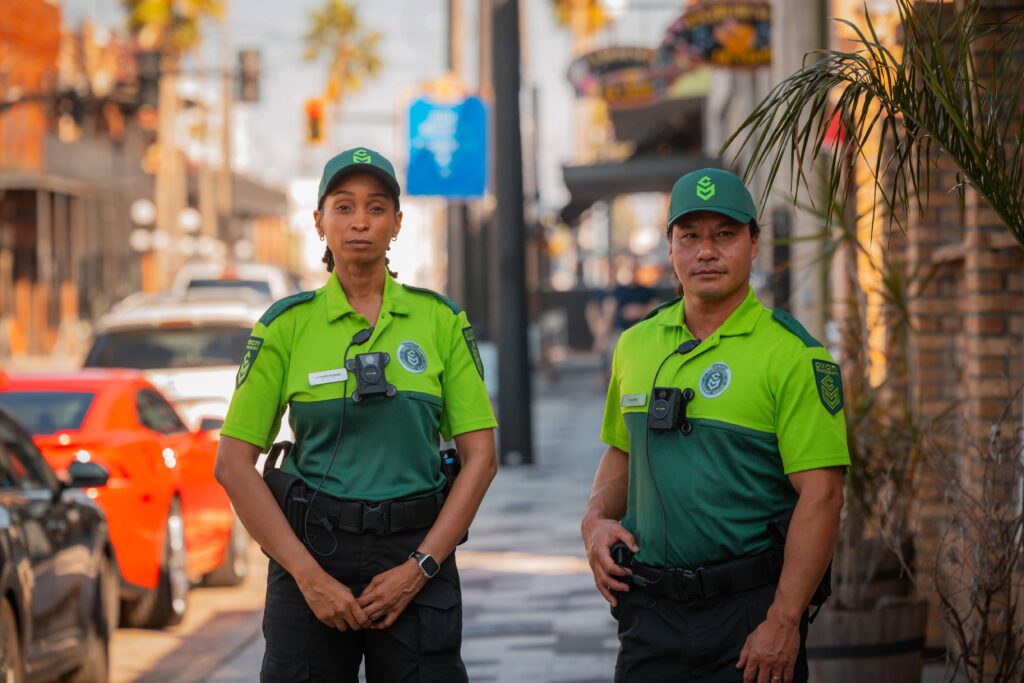
Two Civicity Community Response Officers stand on a vibrant downtown street. One woman and one man wear bright green and dark green color blocked shirts with badges and body cameras with a green hat showing the Civicity logo

“Having a body in a uniform carries a feeling of safety and responsibility,” Saunders said. “That visibility can deter problems before they start.” 

Although unarmed, CROs are equipped with body cameras, communication tools, and pepper spray. More importantly, their training emphasizes de-escalation and decision-making. 

“The number one tool a CRO can have is emotional intelligence,” Saunders said. “It’s about thinking through problems and responding in a way that prevents escalation.” 

CROs are trained to look beyond immediate incidents and focus on underlying causes. They work with cities, businesses, and community partners to improve conditions, connect unhoused individuals with resources, and reduce recurring issues. 

“We’re looking at what’s causing problems and how to address them,” Saunders said. “That lets us work together to reduce or eliminate them over time.” 

And CROs are designed to complement, not replace, law enforcement. 

“Many departments don’t have the bandwidth for traditional beat policing,” Saunders said. “Our CROs can act as force multipliers, providing additional visibility and engagement.” Because of this, relationships with local police tend to be collaborative and positive. 

Training combines virtual reality simulations with real-world scenarios to prepare CROs for complex interactions. 

“Our goal is adaptability,” Saunders said. “We want CROs to be ready to engage with people who may be disruptive or experiencing mental health challenges—and to do so safely and effectively.” 

Civicity was developed in response to growing demand from clients seeking expanded safety solutions. 

“We know there’s a need,” Saunders said. “And we’re ready to meet it.” 

Civicity CROs vs. Traditional Security Models

 Civicity Community Response Officer (CRO) Traditional Security 
Core Purpose Protects the experience of public spaces ensuring people feel safe, welcome, and confident Focuses primarily on protecting property within a defined space  
Approach to Safety Human-centered, engagement-first approach built for modern public environments Typically, enforcement and observation-focused within a set area  
Presence in the Community Highly visible, approachable, and actively engaged in the public realm Often positioned as a static or reactive presence within a property  
Response to Issues Proactively identifies, assesses, and resolves issues in real time Often observes and reports, with escalation handled externally  
Handling Complex Situations Trained in de-escalation, behavioral health awareness, and community-based problem solving Not typically designed for complex public-space challenges like disorder or quality-of-life issues  
Community Impact Focuses on building trust, improving perception, and supporting long-term outcomes Focuses on incident prevention and response within a defined scope 
Role in Public Spaces Embedded in the community supporting residents, visitors, and businesses Typically assigned to a specific property or asset 
Problem-Solving Approach Addresses root causes and partners with outreach and stakeholders to reduce recurring issues  Primarily addresses individual incidents as they occur 
Training & Skillset Purpose-built training in communication, emotional intelligence, and real-world scenarios  Often based on standardized guard training models  
Team & Deployment Model Coordinated, team-based units designed for coverage, flexibility, and rapid response  Often utilizes individual posts or isolated coverage  
Technology & Accountability Supported by real-time reporting, body cameras, and data-driven insights  May rely on basic reporting with limited transparency or data visibility  
Overall Outcome Creates safer, more welcoming, and more vibrant public spaces Provides security coverage for defined assets and locations